Get out of debt years sooner. Then breathe again.
Most payoff plans fail because the finish line is invisible. Type in rough balances and Atlas shows when debt can end, what to pay first, and how each win rolls forward.
No account. No bank connection. Your numbers stay on your device.
- A debt-free date you can actually see, not just a pile of balances.
- Rough numbers work. Real numbers work better. No account connection either way.
- The exact payment to make this month, on the exact debt to make it on.
- A clear rollover plan so every paid-off minimum keeps working.
The small one goes first
Not because the math says so. Because you need to see something close. The first paid-off debt is fuel for the rest.
One job at a time
Minimums everywhere. Extra in one place. Seven worries become one move per month.
The payment gets heavier
When a debt is gone, its old payment rolls onto the next one. The budget stays the same. The attack gets bigger.
When one debt disappears, keep pretending that payment is due.
Pay minimums on everything. Put your extra money on the smallest debt. When that debt is gone, send its old payment to the next debt. Nothing new comes out of your budget, but the next payment gets bigger.
Example snowball
Same budget. Bigger target payment each time a debt is paid off.
Debt 1
Store card
$50 minimum + $300 extra
Pay
$350
Debt 2
Medical bill
$75 minimum + the paid-off store card payment
Pay
$425
Debt 3
Credit card
$150 minimum + the first two old payments
Pay
$575
One rule: when a debt is gone, the payment doesn't get absorbed back into spending. It rolls forward.
Compare motivation, interest, and monthly relief.
Snowball
Best when you need proof fast. Pays off fewer open debts first; easier to keep using when motivation dips.
Avalanche
Best when interest savings matter most. Pays the most expensive APR first; slower to feel like progress.
Cash-flow
Best when monthly cash is tight. Frees up required minimums first; the plan stays survivable.
The story is simple. That is why it works.
Start with the smallest debt
Not the most dramatic one. The smallest one. The first win matters.
Roll the payment forward
Pay one off, then add that old payment to the next debt. The snowball gets heavier.
Let progress become pressure
Every payoff frees cash, shortens the timeline, and makes quitting feel expensive.
The free planner is generous on purpose.
Snowball plan
A clear payoff order. The first one to kill, then the next one after that.
Debt tracker
Balances, minimums, extra payments. The part nobody likes typing in.
Momentum view
Watch each paid-off payment join the next attack instead of disappearing into spending.
Payoff timeline
Month by month, debt by debt. The finish line stops being theoretical.
What-if scenarios
Extra fifty bucks, a tax refund, a skipped impulse buy. The math answers quietly.
Manual save file
Download the CSV. Reload it later. The plan rides with you between devices.
Free gets you moving. Pro keeps the plan with you.
The whole planner. Manual CSV save. No account required.
- Unlimited manual debts
- Snowball, avalanche, and cash-flow views
- The next payment to make this month
- Charts, payoff steps, debt-free date
- Promo deadline warnings
- Snowflake payments — holiday cash, refunds, windfalls
- Google Sheet workbook you can fill in
- Manual CSV save and reload
- No account required

Pro workspace
Login, cloud sync, and the kind of PDF you'd actually hand to someone.
- Everything in Free
- A private login (the Queen keeps the keys)
- Cloud-saved plan and progress
- Same plan on every device
- A PDF you would actually hand to someone
- Your record: months logged, streak, real progress
- Printable debt-by-debt payoff table
- Every future Pro upgrade, included
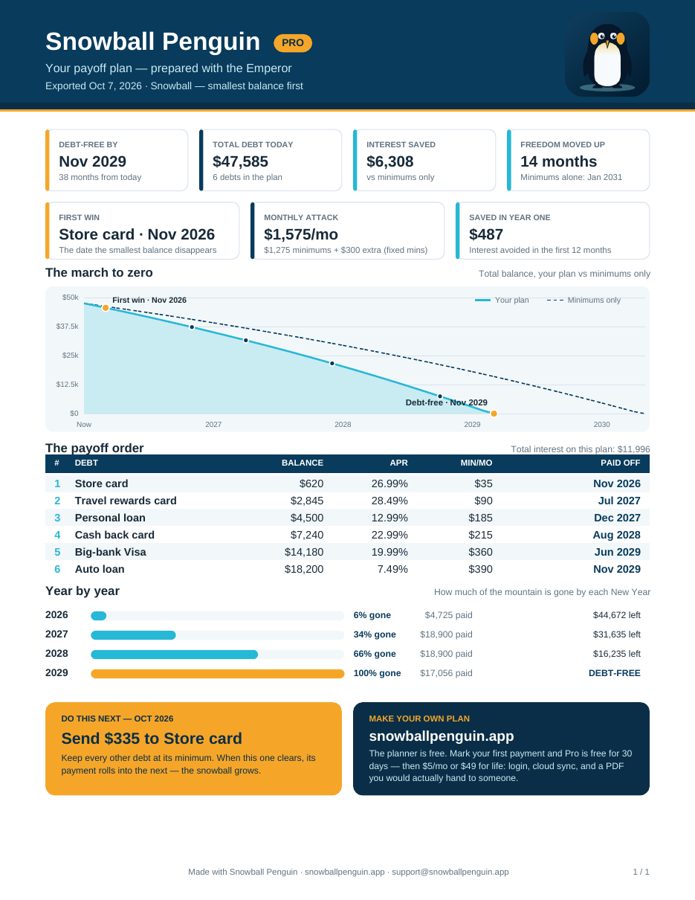
The Pro PDF, on the demo plan — tap to see it full size
Why the snowball works
Debt payoff is not just arithmetic. It is attention, repetition, and proof. The smallest balance gives you proof fastest. Proof is fuel.
Meet Atlas
Atlas is your ant — calm, blunt, on your side. Spreadsheets can do the math. Atlas sits with you while you read it: which balance goes first, what rolls forward, and when the last payment finally leaves.
The research backs the bias
Studies on small victories find that visible progress helps people stay with hard, long work. The app shows snowball, avalanche, and cash-flow side by side so you can pick with the math and the motivation both in view.
Questions before the first payment hits.
Why snowball instead of highest interest first?
Because behavior matters. Avalanche is efficient. Snowball is sticky. The first paid-off debt changes the room.
What if my highest-interest debt is not the smallest?
Compare both. Snowball keeps you moving; avalanche saves more interest. The app shows the tradeoff so you stop guessing.
Can I use this if I can only pay minimums?
Yes. Start with minimums. The plan still gives you a baseline. When extra money shows up, drop it in and watch the date move.
Can I add a one-time windfall?
Yes, free. Holiday cash, refunds, bonuses, a skipped impulse buy — drop a snowflake payment in and watch the date move.
Is this financial advice?
No. It is planning software. Use it to see the path. If the situation is complicated, bring the plan to a qualified advisor.
Is the free version actually useful?
Yes. Free is the planner, not a teaser. Strategies, charts, promo warnings, check-ins, CSV save — all in.
What does Free not do?
Free does not login or sync to the cloud, and it does not print a polished PDF. Save the CSV, reload it on the next device — the manual version of what Pro does for you.
Why would I pay for Pro?
Pro turns the local planner into a saved workspace: login, cloud-saved progress, and a PDF you would actually hand to someone.
Do I need to create an account?
No. No email gate. No password. Start with the debts in front of you.
Is my data private?
Yes. Your browser keeps the file — no account needed, and your balances never leave your device unless you sign in for cross-device sync. The privacy policy spells out exactly what that means.
Can I get a refund?
Yes. 30 days, no questions asked. Some exits should be simple.
One debt disappears.
Then the next one gets nervous.
Build the free plan now. Upgrade only when you want login, cloud sync, and a polished PDF.